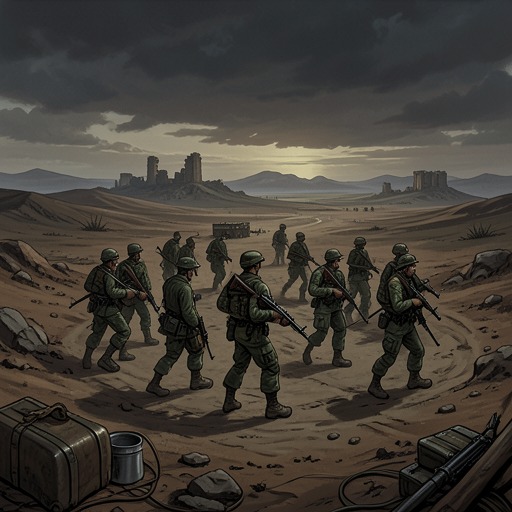
The destruction of the Cyclops by the Invincible
The InvincibleThe destruction of the Cyclops by the Invincible is both a military victory and the moment when victory becomes ethically and strategically unstable. The Cyclops, previously an instrument of reconnaissance and protection, turns its weapons against the ship’s probes and forces Horpach to choose between continued exposure and an attack of extraordinary destructive power. The resulting antimatter strike smashes the machine, but it also breaches the Invincible’s force field and makes the human response resemble the planetary violence the crew had hoped to master.
Causes and Strategic Background
The immediate crisis develops from the black mechanical cloud’s encounter with the Cyclops. The cloud can scatter when struck, regenerate after losses, multiply, move freely across the planet, and remain unaffected by forces fatal to living organisms. Horpach’s assessment is that these mechanisms are not guided by a powerful intellect or a strategic plan; they attack from one opportunity to the next and continue processes established over millennia. Their ability to obstruct communication, especially through the metal cloud’s capacity to block radio waves, is understood as an inherited function of an inanimate evolutionary system rather than as evidence of deliberate hostility.
That distinction changes the meaning of the proposed attack. Horpach argues that the crew must protect itself and its automatons, without which human activity would be impossible, yet he also concludes that the Invincible cannot annihilate every component of the system. The cloud can disperse, relocate, and regenerate; destroying it on one continent would merely drive it to another. His strategic conclusion is therefore that the expedition should leave Regis III rather than pursue total extermination. The attack on the Cyclops occurs within this unresolved contradiction: the crew recognizes that the planetary mechanisms are not a conventional enemy, but still faces an armed machine whose immediate actions cannot be ignored.
The Cyclops Turns on the Invincible
During the battle near the ravine entrance, the Cyclops slowly reverses toward more open ground while continuing to fire. Its movement may reflect an attempt to avoid being trapped by collapsing cliffs, but the machine’s precise calculation remains uncertain amid atomic explosions, smoke, fire, crushed rock, and the remnants of the cloud. The struggle appears to reach its climax when a burst of antimatter converts the air, debris, steam, gases, and smoke around the Cyclops into extremely hard radiation, splitting the ravine and enclosing the cloud in an annihilating blast.
The Cyclops survives the devastation. As the cloud withdraws toward the ravines, the machine remains apparently unharmed, still reversing and firing at boulders, sand, and dunes. It then stops its barrage, turns, and accelerates across the desert, followed by the television probe. Without warning, it fires at the probe. The visible filament is the trace of particles annihilated along the shot’s path, and the image disappears. Horpach orders another probe launched, but the Cyclops destroys that one as well; the Invincible is only six miles away when the second probe is lost.
The response becomes a grim repetition. A third and a fourth probe are launched, and the Cyclops shoots them down one after another. Each probe is meant to restore knowledge and distance, yet each launch becomes another opportunity for the machine to demonstrate that it can eliminate the expedition’s eyes at will. The ship’s personnel are left confronting an impossible reversal: the Cyclops is no longer merely a vehicle operating in the planetary crisis but an armed force actively denying the Invincible’s ability to observe and assess the situation.
Horpach’s Full-Power Decision
Horpach orders full power while watching the screen. When the chief engineer warns that the core casing is too cold, Horpach repeats the command with greater force rather than retreating from it. The engineer reaches for the main breaker, alarms sound through the ship, and the crew runs to battle stations. At that instant everyone understands that the commander is preparing to engage the Invincible’s own Cyclops in battle.
The preparation is described as a mobilization of the entire technological body of the ship. Indicators line up across the displays, power figures rise into five- and six-figure ranges, a cable sparks, and technicians signal to one another while activating the necessary control systems. The Invincible stands locked down beneath its force field as probes continue to rise from its bow and are destroyed. Rohan knows that the ship can withstand antimatter fire, but the percussion energy must still be absorbed, draining the reserves that sustain its protection. The weapon therefore promises survival only by converting the ship’s remaining capacity into a single irreversible act.
The attack also follows a moral hesitation rather than a simple desire for revenge. Rohan reflects that the expedition has lost men because it trusted its cannons and sensors too much, made mistakes, and now attempted to pay for those mistakes with further violence. He rejects the idea that humanity has earned the right to impose its own measure on every form of existence. Regis III has developed an active equilibrium over millions of years, one dependent on radiation and material forces rather than on life as humans define it. In this light, destroying the Cyclops is not the fulfillment of a heroic human mission but a reversal of the understanding Rohan has just reached.
The Antimatter Strike and Its Immediate Cost
The final exchange is conducted at extreme range and with mounting uncertainty. The Cyclops continues moving through rock-strewn terrain, while the Invincible launches another probe and prepares for direct contact. The ship remains in full battle readiness beneath its force field, and the camera mounted on the ship’s prow extends upward to improve vision. The Cyclops does not appear to be heading directly toward the Invincible, but its repeated destruction of the probes has already made further restraint increasingly dangerous.
The engagement ends in a detonation so large that it transforms the entire vicinity of the Cyclops into an annihilating field. The explosion reaches roughly half a mile across, bursts into the air like the eruption of the planet’s interior, and produces seismic waves that travel forty miles to the Invincible. The ship rocks; transporters and energobots shift near the ramp; a delayed wind blows from the mountains and drives a wall of spiraling sand across the desert. Even a television probe eight miles from the center of the devastation is damaged, though its connection briefly survives with heavy interference.
The Cyclops is smashed to pieces outside the ship’s triple perimeter, and the immediate skirmish is effectively over. Yet the Invincible has not escaped unharmed. Radiation readings reach 20,600 roentgens at ground zero, 9,800 at the perimeter, and 1,422 inside the force field. The figure inside the field proves that the radiation has penetrated the shield, something Rohan had not believed possible. The scale of the expenditure is equally alarming: the released energy would have been sufficient to boil the water in a medium-sized continental sea. Horpach has removed one adversary, but he has done so with a charge powerful enough to threaten the very protections on which the ship depends.
Consequences and Significance
The destruction reduces the number of immediate adversaries to one, but it does not resolve the larger conflict with the black mechanical cloud. Horpach’s earlier analysis remains intact: the cloud can scatter, regenerate, and move beyond the reach of any single attack, while the human expedition must remain continuously protected and therefore strategically constrained. The Cyclops’s destruction is consequently a local success inside a conflict that cannot be won by local annihilation.
The event’s central irony lies in the gap between intelligence and power. Horpach believes the planetary mechanisms lack a commanding intellect because they do not behave according to a unified strategic plan; nevertheless, their inanimate adaptability makes them almost impossible to defeat. Humans may be intellectually superior, yet they are vulnerable to the environmental conditions that the mechanisms exploit. The Invincible’s technologically spectacular response exposes the same imbalance from the opposite direction: human weapons can destroy a single machine, but the required force produces planetary-scale consequences and damages the ship’s defenses.
Rohan’s recognition gives the event its deepest consequence. He has just reached what he calls a galactocentric understanding: humanity should not interfere in an existence that does not concern it merely because that existence is unfamiliar. The sirens immediately interrupt this insight, drawing him back into the ship’s emergency and then into the sensory shock of the battle. The destruction of the Cyclops thus stages a conflict between ethical comprehension and military necessity. The crew survives by acting against the principle Rohan has understood, and the radiation inside the force field remains as the physical evidence of that contradiction.